
Showing posts with label Book Reviews. Show all posts
Showing posts with label Book Reviews. Show all posts
Wednesday, February 11, 2026
A How-To Commentary

Wednesday, January 7, 2026
The Best Book I Read Last Year

Wednesday, August 6, 2025
Truths That Take On the World

Wednesday, June 4, 2025
How Not to Apply the Bible

This is sort of going to be a book review, but I want to focus on one glaring, and unfortunately common, problem in a book that is otherwise ... unimpressive but fine.
Wednesday, April 30, 2025
Murder and Meaning

Thus begins an interesting new project from apologists and police detectives J Warner Wallace (of Cold-Case Christianity fame) and his son Jimmy Wallace called Case Files: Murder and Meaning. Why are apologists writing crime fiction? Well, crime is what they know. But fiction, that has been used for centuries to ask the big questions.
Wednesday, November 20, 2024
Joy in a World Gone Mad

I want to tell you about a book that offers a compelling answer to that question. It's "a book about joy" written "to help you experience life to the fullest."
Wednesday, September 27, 2023
The Gift of Daniel

Wednesday, August 9, 2023
A Manual for Manhood

Wednesday, May 31, 2023
How WEIRD Values Became Normal

We hold these truths to be self-evident, that all men are created equal, that they are endowed by their Creator with certain unalienable Rights, that among these are Life, Liberty and the pursuit of Happiness.
But for most of human history, those truths would have been anything but “self-evident.” Those ideas were actually pretty new, and they were thoroughly Christian, yet today most Westerners hold these values. How did this happen?
Wednesday, February 1, 2023
C.S. Lewis the Prophet

This year is the 80th anniversary of CS Lewis’ most prophetic book, The Abolition of Man. You can find it on “best books of the 20th Century” lists. Philosopher Peter Kreeft includes it in his “books to read to save Western Civilization.”
This short book consists of three chapters and an appendix, 101 pages before notes. In those three chapters, Lewis examines the problem with moral subjectivism and explores where it would take society. Where it will take society is to today. He described the last sixty years, eighty years ago.
Wednesday, June 22, 2022
Is Atheism Dead?: The Good, The Bad, and The Ugly

In principle, it’s a worthy endeavor. In the actual execution, it’s a bit of a mixed bag.
Wednesday, May 4, 2022
The Story of the Expressive Individual Self

Carl Trueman answers that question in his latest book Strange New World: How Thinkers and Activists Redefined Identity and Sparked the Sexual Revolution (of which I received a free review copy). We all know about the sexual revolution, and we all know what’s going on now is related to it. What Trueman reveals, however, is that the pattern of thought that became the sexual revolution began 400 years ago. “I am a woman trapped in a man’s body” is a direct descendent of “I think; therefore, I am.”
Tuesday, February 8, 2022
Biblical Clarity in a Secular Culture

That’s over now. The bubble has popped, and the real world is rushing in on us. How are we going to respond? We will only maintain a biblical view of truth and morality if we’re very intentional about it.
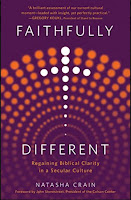
That’s the purpose behind Natasha Crain’s new Faithfully Different: Regaining Biblical Clarity in a Secular Culture. You may recognize her name from her three books about discipling your kids. This one is primarily focused on you, but your kids need this too.
Her message is that it’s no longer normal to be a traditional Christian in our culture. Secularism is the way everyone thinks now. Secularism isn’t just not-religion; it is very specific assumptions about the world and the way things ought to be. And these ideas are very seductive, even for Christians. However, if we’re careful and intentional, we can maintain (or, if necessary, regain) the biblical worldview, which includes the supernatural, meaning determined by our creator, and objective moral truth. She lays out the biblical view on things we ought to believe, how we should think, and the way we ought to live. Each chapter ends with some recommended reading for those wanting to explore the topic further and questions for discussion or reflection (good for private meditation or group discussion).
There is a lot of good stuff here, but the thing that makes this book unique is where Natasha applies her marketing background to the way secularism slowly wins people over to its way of thinking. It’s insidious. And perfectly organic. It appeals to what fallen humans want and pressures those who resist. Being aware of it will help you defend yourself against it and reaffirm biblical morality. This chapter is worth the purchase price for the book.
This is one for parents and non-parents, for college kids and pastors. The church needs to figure out how to resist the secularizing forces in our culture. The world is starting to push on us in a way it hasn’t before in the West. We will be conformed to the pattern of this world if we do not take steps to push back. And if we fall, will our kids be able to resist? Take up and read!
Bubble image via Pixabay
Wednesday, January 19, 2022
What is CRT?

Where better to turn for answers to these questions than one of the founders of the movement? Critical Race Theory (Third Edition) by Richard Delgado and Jean Stefancic (his wife, so hereafter, the Delgados) is a popular level introduction to the movement among legal scholars and civil rights activists. This is not going to be a book review: Rather than waste time telling you what a poorly written book this is, I’m just going to distill its contents as a series of questions it should have clearly answered.
The authors frequently emphasize the variety of thought among CRT proponents (called “crits”), and this book — first written in 2001 and revised in 2017 — cannot tell us how it has evolved in recent years, but I think it is fair to say that CRT is at minimum what the Delgados describe.
Because this is going to be longish, here is an outline for those who want to skip to a specific question.
Premises
What is CRT?
What do crits believe about race and racism?
What is racism?
Why do white people do this?
What responsibility does an individual white person bear for this system?
How can our society learn about race?
The Goals of CRT
What do they want?
How would we achieve their goals?
Is CRT “just a legal theory?”
Is CRT anti-Christian?
Conclusion
Wednesday, October 6, 2021
Jesus' Incomparable Character
Two things that are required to make a fictional character interesting are flaws and character growth. Sherlock Holmes’ brilliance would be completely insufferable if he wasn’t also an egotistical jerk with terrible social skills. Batman’s superpower of awesomeness would be intolerable if it weren’t for his trust issues and the relationship problems they force him to navigate.
So how can Jesus be such a compelling character? He has an impeccable moral character. He never misspeaks, never makes a misstep. He never misunderstands anyone and always has the perfect response ready. Today such a character is called a “Mary Sue” and derided as completely uninteresting. But he’s not.
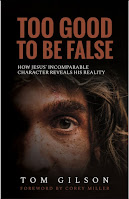
Tom Gilson’s new book Too Good to Be False: How Jesus' Incomparable Character Reveals His Reality shows that the life of Jesus as portrayed in the gospels is something different from any other person in history or in fiction — a character that is “too consistent, too unique, and too extraordinarily good to be mere legend” that still manages to be magnetic. “In both history and literature, the powerful people are never the noble, self-sacrificial people.” Except Jesus. He’s the one person whom absolute power did not corrupt.
This book catalogs the things in Jesus’ life we overlook because we’re too used to them: amazing things in his character, the way he leads, the things he never says, and other truths we’re too familiar with to notice. “I’m not saying it leads to ‘new truths,’ for most ‘new truths’ in Jesus studies are deceptive and false; they’re the stuff that cults are born of. These discoveries are of the ‘how much more’ variety instead: how much greater, more loving, more clearly God, our Savior is and was than I’d ever realized.”
This serves as an apologetic argument. Skeptics say Jesus’ miracles are impossible. Take those away, and he’s just an ordinary moral teacher — “a ‘fairly ordinary rabbi story,’ plus special effects.” What Gilson shows is that his character eclipses his miracles in improbability. He also shows that such a character, even if one person could create such a thing, cannot have come about by the communal evolutionary process skeptics claim created the gospels.
However, I don’t really know how many skeptics will be persuaded by this line of argument. Let’s face it, most skeptics are skeptical of everything but their own skepticism. Those who are wavering or wondering, perhaps the curious and the seekers, may find this persuasive. But not the Dawkins fanboys.
And Gilson knows that: “This book isn’t primarily about rounding up skeptics’ ideas and proving them wrong, anyway. It’s mostly about gaining a fresh new vision of Jesus. My primary aim, for those who are already convinced he’s worthy of their worship, is to show you even more reasons to fall on your knees in wonder before him.”
Yes, apologetics can lead you to worship. I know because I experienced it in Tom Gilson’s new book. I think it will do that for you, too.
So how can Jesus be such a compelling character? He has an impeccable moral character. He never misspeaks, never makes a misstep. He never misunderstands anyone and always has the perfect response ready. Today such a character is called a “Mary Sue” and derided as completely uninteresting. But he’s not.

Tom Gilson’s new book Too Good to Be False: How Jesus' Incomparable Character Reveals His Reality shows that the life of Jesus as portrayed in the gospels is something different from any other person in history or in fiction — a character that is “too consistent, too unique, and too extraordinarily good to be mere legend” that still manages to be magnetic. “In both history and literature, the powerful people are never the noble, self-sacrificial people.” Except Jesus. He’s the one person whom absolute power did not corrupt.
This book catalogs the things in Jesus’ life we overlook because we’re too used to them: amazing things in his character, the way he leads, the things he never says, and other truths we’re too familiar with to notice. “I’m not saying it leads to ‘new truths,’ for most ‘new truths’ in Jesus studies are deceptive and false; they’re the stuff that cults are born of. These discoveries are of the ‘how much more’ variety instead: how much greater, more loving, more clearly God, our Savior is and was than I’d ever realized.”
This serves as an apologetic argument. Skeptics say Jesus’ miracles are impossible. Take those away, and he’s just an ordinary moral teacher — “a ‘fairly ordinary rabbi story,’ plus special effects.” What Gilson shows is that his character eclipses his miracles in improbability. He also shows that such a character, even if one person could create such a thing, cannot have come about by the communal evolutionary process skeptics claim created the gospels.
However, I don’t really know how many skeptics will be persuaded by this line of argument. Let’s face it, most skeptics are skeptical of everything but their own skepticism. Those who are wavering or wondering, perhaps the curious and the seekers, may find this persuasive. But not the Dawkins fanboys.
And Gilson knows that: “This book isn’t primarily about rounding up skeptics’ ideas and proving them wrong, anyway. It’s mostly about gaining a fresh new vision of Jesus. My primary aim, for those who are already convinced he’s worthy of their worship, is to show you even more reasons to fall on your knees in wonder before him.”
Yes, apologetics can lead you to worship. I know because I experienced it in Tom Gilson’s new book. I think it will do that for you, too.
Tuesday, August 10, 2021
The Truth About the Color of Compromise

After an introduction, Tisby begins with a historical survey of the many awful things white Americans — and particularly white Christians — have done to black people. He begins in the colonial era and continues through 2019. Some of it you’ve heard before, but some of it will be new. Much of it is terrible. There’s a whole lot of human depravity on display. Then he offers things he thinks will help white Christians make amends to and peace with black Christians.
So how’d it go?
Tisby says, “The goal of this book is not guilt.” Yes it is. His whole enterprise depends on white people feeling guilty. The question is whether they ought to feel guilty. Set aside for the moment the question of our responsibility for the sins of our forebears. What have today’s white Christians actually done to black people?
The Modern Christians' Sin
He gets into this in Chapter 9, “Organizing the Religious Right at the End of the Twentieth Century.” A repeated refrain in this book is “racism never goes away; it adapts.” What form has racism taken in the post-Civil Rights era? Talk about “law and order”, “state’s rights” (aka federalism), and “limited government” is racist. So is opposing racial set-asides, abuse of the welfare system, and communism. Claiming that capitalism will lift poor black people out of poverty? Racist. Stiffer punishment for drug offenses involving crack cocaine? Racist, even though it was supported by the Congressional Black Caucus.1
In short, white evangelicals are still racist today as demonstrated by their tendency to vote for conservative Republicans. Because conservative Republicans are racists as demonstrated by their tendency to support policies Tisby doesn’t agree with.
And, of course, they voted for Trump in large numbers (Chapter 10). He trots out the usual “proof” of Trump’s racism: a housing lawsuit from 1975. An ad calling for a return of the death penalty in NY in 1989. Questioning Obama’s citizenship. The wall. The “ban on Muslim immigration” that wasn’t. A tendency to quote the wrong news sources. He is a racist, so people who voted for him are racist.
He eventually admits, “Evangelical support for Donald Trump can be attributed to a combination of policy issues they thought he would champion as well as an intense dislike of Hillary Clinton.” And “White evangelicals looked to Trump to support their pro-life stance. They wanted him to oppose gay marriage and, of vital importance, to appoint conservative Supreme Court justices who would protect and promote their policy interests.”
But that doesn’t matter because Trump is a racist, and “Black people recognized the pattern of prejudice from Trump, and they showed their distaste at the polls. Eighty-eight percent of black voters ... supported the Democratic candidate Hillary Clinton. By contrast, 58 percent of white people voted for Trump.” Of course, Bill Clinton garnered 83% of the black vote in 1992,2 Gore 90% in 2000, and Kerry 88% in 2004, so maybe black people are just reliably Democratic voters and their rejection of Trump is nothing special. It seems like he’s trying to spin a narrative here. (Frankly, he wants white evangelicals to vote Democrat. We’ll come back to this.)
Ultimately “Christian complicity with racism in the twenty-first century looks different than complicity with racism in the past. It looks like Christians responding to black lives matter with the phrase all lives matter. It looks like Christians consistently supporting a president whose racism has been on display for decades. ... It looks like conversations on race that focus on individual relationships and are unwilling to discuss systemic solutions.” In other words, if you didn’t want to support the BLM organization, voted for Trump, and/or don't think the nation is still structurally racist, you're a racist.
Generational Guilt
So that covers our racism today. Are white Christians responsible for the racism of the past? His case that we are is limited to a section of the last chapter where he talks about reparations. Other authors have gone into much more detail making the case for reparations, so maybe he didn’t feel the need or didn’t want to dedicate the space to a more thorough case. He should have. A couple of pages that take a few Bible passages out of context are not convincing.
He thinks the church today (ie, of the last 40 years or so) is not only responsible for our forebears’ sins but is just as guilty of racism as those who defended slavery. That claim bears a burden of proof he does not meet. So where does that leave us?
If the diagnosis is wrong, the proffered cure is questionable. But I do want to look at some of what he prescribes.
He wants us to be more aware of racism by watching documentaries about racism and following “racial and ethnic minorities and those with different political outlooks than yours” (emphasis added) on social media, listening to their podcasts, and reading their blogs. I doubt he means Voddie Baucham, George Yancey, and Thomas Sowell. He wants you to find black liberals to listen to.
He wants us to make friends with ethnic and racial minorities. That’s great. Everybody needs more friends. That’s easier said than done, or we’d all have more friends.3
And he tells us to develop a lifelong commitment to racial justice by doing things like joining an organization that advocates for racial and social justice (these organizations are, of course, completely apolitical on issues outside “racial and social justice”), donating money to these organizations, and by voting. But Republicans are racists, so ...
And he wants us to create “Freedom Schools” to teach everyday [white] Christians about “systemic injustices such as mass incarceration, police brutality, underfunded schools, and healthcare inequality.” By now I think it’s fair to assume he means the Democratic take on all these issues.
Then he offers some better ideas. As part of reparations, he wants white churches to “pool resources to fund a massive debt forgiveness plan for black families.” I could get behind that ... if we didn’t limit it to blacks. He suggests funding black-led church plans and religious organizations. “Black Christians have an abundance of innovative ideas ... What they often lack is funding.” Well, what most churches lack is funding. There are far more poor white churches than there are rich ones. But the idea isn’t terrible if we see it as rich churches sharing with poor churches (something my church has a history of). He also recommends funding currently bivocational pastors so they can just pastor. Much of what he says I could get behind if we’re not approaching it as something someone “owes” someone else but as the way the rich in the Church could share their wealth with the poor.
CRT
How does this book relate to Critical Race Theory? It doesn’t use the name at all, but it does share some of the ideas Voddie Baucham warned about. For example, “racism is a system of oppression based on race” or “racism as prejudice plus power.” So while anyone can be prejudiced, only white people can be “racists.” He never straight up says, but he strongly implies that all white people are racist, and they’re definitely all complicit in this system of oppression. He also never says but obviously assumes that unequal outcomes are proof of racism.
Conclusion
I am surprised by the reports that so many pastors have been so profoundly affected by this book. It did not have that effect on me. One reason might be that for some reason I read Chapters 9-11 first then went back to the beginning. I saw how terribly he handled the period I lived through and know something about. Perhaps if you started at the beginning, revisiting how horrible human beings can be to each other, you might be less critical when you read Chapters 9 through 11. However, it seems obvious to me his “proof” of our racism today is our failure to vote Democratic, and his solution for it is largely to vote Democratic. Your feelings about the Democratic Party one way or the other shouldn’t keep you from seeing that this is more about politics than race. He wants your guilt over racism to convince you to vote Democrat as penance.
Chapters 1-8 will take you through the terrible, terrible, terrible history of white people being inhumane to black people in this country. Not only did people who claimed to follow Christ fail to stand up for what was right, they very often sided with the wrong. We can talk about “cultural blindspots” all we want, but there have been Christian abolitionists since at least Gregory of Nyssa (d. 378). There were certainly abolitionists in the colonies and in the fledgling United States. That people chose to go along with their culture instead of listening to the scriptural opposition to the institution of slavery is inexcusable. But you have to do more than take a few scriptures out of context to prove that we are responsible for their sin today.
We have to acknowledge the gross sins of the people who came before us, just as we have to acknowledge ours. And we have to keep it in perspective — we’re all sinners. If God can use Peter and Paul, God can use anyone. We shouldn’t give Jonathan Edwards a pass on slavery, but it doesn’t disqualify everything he ever wrote, just as Martin Luther King’s adultery doesn’t disqualify everything he did.
The book is probably worth reading if you want the history lesson in the first 8 chapters, but Chapters 9 and 10 are not a good use of your time. Chapter 11, has some good ideas mixed in with some bad ideas. I would love to see the Church being the Church, the rich sharing with the poor, showing the world what the love of Christ should look like. I just don’t want us doing it out of a misplaced sense of guilt.
1 If Tough Anti-Drug Laws Are 'Racist,' Blame Black Leaders
2 https://en.wikipedia.org/wiki/1992_United_States_presidential_election#Voter_demographics
3 Especially men, since “according to a recent survey, the percentage of men with at least six close friends has fallen by half since 1990, and men today are 5X more likely to say they don’t even have a single close friend than they were thirty years ago.” https://www.artofmanliness.com/articles/male-friendship-recession/
Wednesday, June 2, 2021
Help for Keeping the Faith in College

Kruger says he hopes his book "provides an intellectual pathway for Christian students so that they can keep their faith without sacrificing their intellectual integrity.” No one book can answer every question that a person may have, and this one certainly doesn't, but this "volume is designed to be [the] first step, an initial orientation for Christian students about the challenges they face and (hopefully) a reason for them to be confident that there are answers to their questions, even if they don’t have them yet.”
Again, it doesn't cover every possible objection skeptics raise, but it does answer many, and it covers some specific challenges and doubts college students face, such as "I'm worried about this, can I survive?" and "My professors are really smart; isn't it more likely they're right and I'm wrong?" These were all very good. Then it covers objections to Christian exclusivism ("How can we say Christianity is the only right religion?"), homosexuality, hell, evil and suffering, "science explains away God", and various objections to the Bible. Again, they're all well done, but nothing that hasn't been done just as well elsewhere, though I particularly enjoyed his response to "tolerance" and moral relativism.
The book is comforting in places, assuring readers, for example, that non-Christian professors aren't usually evil and your fellow students aren't generally out to get you. But, he reminds us, we shouldn't have "naive overconfidence," either. And, though it may surprise us, "there’s a certain spiritual depth, and a certain spiritual strength, that we will never reach without going through an intense season of doubting and struggle.”
Who is this book for? It's not written to convince the unbeliever but to shore up the confidence of the believer whose faith is being assaulted. This is not a good choice for an unbeliever, even though it may contain answers to their questions. It's written for college students; I don't know if it would be well-received by teens not going to college, even though they'll meet most of these objections in modern society.
Also, it's written as a series of letters to the author's daughter Emma. It creates a conversational tone, keeping the book from feeling too much like a lecture, but I don't know if that format will turn off some readers.
So the book is not unique, and it's not for everyone, but it does what it does well. Churches could do worse than hand a copy of this to every student heading off to college. (Let's be honest, most do much worse — nothing.)
Thursday, May 20, 2021
The Ground is Shifting Under Evangelicalism

In Fault Lines: The Social Justice Movement and Evangelicalism's Looming Catastrophe, Dr. Voddie Baucham, pastor, theologian, and currently dean of the School of Divinity at African Christian University in Lusaka, Zambia, tries to warn the church away from what he calls "Critical Race Theory/Intersectionality" (CRT/I). This isn't some old white guy afraid he's going to lose his power. This is a black man who currently doesn't even live in the US who's afraid that CRT/I will turn Evangelicalism into something antithetical to the gospel.
While there are people who are fully on board with CRT, his greatest concern is for those who are "sympathetic to it because of their desire to fight what they see as a problem of racial injustice." Part of the problem is that people confuse modern "social justice" with biblical justice. "There are plenty of sincere, though perhaps naïve Christians who, if they knew the ideology behind it, would run away from the term 'social justice' like rats from a burning ship." So he tries to educate us about what is really going on in this movement.
Critical Race Theorists propose the idea of antiracism as the cure for racism. There is no neutral position — you are antiracist, or you are racist.
Racism is now “a system of advantage based on race, involving cultural messages, misuse of power, and institutional bias, in addition to the racist beliefs and actions of individuals.” This means racism is part of institutions and structures rather than just human hearts. According to CRT proponents, racial inequality is the proof of racist policies, and since we higher percentage of poor blacks than poor whites, of blacks in prison than whites, ipso facto, America is guilty of systemic racism.
White supremacy has also been redefined. "This is not your grandfather’s version of white supremacy. It does not refer to the KKK or Neo-Nazis (except when it does). This version refers to the very air one breathes in a culture created by and for white people."
He says Critical Race Theory is not just an analytical tool for addressing race. It is a worldview. In fact, these ideas are the foundation of a new religion:
"The antiracist movement has many of the hallmarks of a cult, including staying close enough to the Bible to avoid immediate detection and hiding the fact that it has a new theology and a new glossary of terms that diverge ever-so-slightly from Christian orthodoxy. ... This new cult has created a new lexicon that has served as scaffolding to support what has become an entire body of divinity. In the same manner, this new body of divinity comes complete with its own cosmology (CT/CRT/I); original sin (racism); law (antiracism); gospel (racial reconciliation); martyrs (Saints Trayvon, Mike, George, Breonna, etc.); priests (oppressed minorities); means of atonement (reparations); new birth (wokeness); liturgy (lament); canon (CSJ social science); theologians (DiAngelo, Kendi, Brown, Crenshaw, MacIntosh, etc.); and catechism (“say their names”). ... In case you’re wondering about its soteriology, there isn’t one. Antiracism offers no salvation—only perpetual penance."
As mentioned above, this new religion has its own priesthood: black (and other minorities, but especially black) voices are elevated above whites. Well, some black voices. Any black person that doesn't toe the line is dismissed as "broken" or having "internalized racism." Black voices are elevated because they have special knowledge (hence his name for this, "ethnic gnosticism") by virtue of their race or position in the oppressor/oppressed scheme.
The idea that really seems to chap him is that people, even otherwise conservative Evangelical pastors, seem to have accepted this as a superior canon for dealing with race, even being superior to the Bible. "In no area does God require me to walk in a level of righteousness for which the Scriptures do not equip me—including any and all aspects of justice." (I will say, however, that I feel like he may have been a little too harsh in some of his criticism of well-known Evangelical pastors, friends of his, over this issue. Some of what he said may be completely justified, but there were times when I think he took more offense than was warranted.)
So what's the big deal? Why all the noise about this? Voddie explores the immediate damage and potential dangers of this movement.
"One of the greatest tragedies of the Critical Social Justice movement is how it promotes devastation by encouraging people and communities of color to avoid 'adopting the dominant culture' by eschewing real data. As Thomas Sowell points out in Discrimination and Disparities, the CSJ crowd 'proclaim that statistical disparities show biased treatment—and that this conclusion must be believed without visible corroborating evidence… unless sheer insistent repetition is regarded as evidence.'"
Also, he thinks this movement is not only racist against white people, it's even racist against black people: "[I]t feeds into a victimology mindset that teaches disadvantaged people that their only hope is the benevolence, good will, and eventual revolutionary political action of well-meaning white saviors."
The potential dangers, however, explain the subtitle of the book, the "looming catastrophe." "One of the unintended consequences of the Critical Social Justice movement is that Christians who adopt its underlying ideologies will not be able to avoid the damage it creates." He and other CRT opponents say it is naïve to believe we can adopt CRT with respect to race and not be affected by it on gender identity, sexuality, and religion. He uses the example of veganism, which some CRT adherents see as a social justice movement connected to environmental justice, racial equality, immigration, worker's rights, and feminism (because meat production exploits female animals).
He then cites examples of Evangelical CRT proponents who hae moved from pro-life to, or at least toward, pro-choice (or pro-choice friendly) positions. Now, correlation does not equal causation; these things could have another source, but it's certainly alarming enough to want to put the brakes on this. It does seem CRT may be about getting people to move left on a host of issues out of guilt over racial injustices.
Voddie quotes several atheists on the anti-CRT side, so this isn't just a religious issue, but it is interesting and sad that they recognize the danger to the church more than many Christians. One formerly "angry" atheist says, "If I wanted to destroy the church, I'd make it woke." And in embracing this self-destructive philosophy, they're embracing an ideology that sees Christianity as part of the "oppressive hegemony." Jemar Tisby, author of The Color of Compromise, is quoted: “Religious freedom… is really code for white Christians being able to do what they want to do.”
Voddie says, "If white people need to 'check their privilege,' then Christians will soon be asked to do the same. Make no mistake about it—we are under attack."
So if CRT isn't the cure for racism, what is? The gospel! "As followers of Christ, we reject the idea that the sin of racism is entirely structural. We believe it is a problem of the human heart—and therefore, its only solution is the Gospel of Jesus Christ. There are most assuredly issues in the culture that are broken, and we should strive to repair them. However, the mission of the Church begins with and works through the hearts of men.
"In the end, it is forgiveness that will heal our wounds. ... I have heard a mantra lately that rings hollow in my ears: 'There can be no reconciliation without justice.” When I hear that, I want to scream, “YES! AND THE DEATH OF CHRIST IS THAT JUSTICE!' ... Who am I to tell a white brother that he cannot be reconciled to me until he has drudged up all of the racial sins of his and his ancestors’ past and made proper restitution? Christ has atoned for sin!"
Turning to a new religion, a new priesthood, and a new canon will not save us. Only the gospel of Jesus Christ as preached by the apostles and passed down in the New Testament can show us the way forward.
What to think of this book? If you couldn't guess from the subtitle, this book makes no pretense of being a calm, dispassionate analysis of the movement. Voddie comes out swinging. He thinks CRT is dangerous and wants you to as well.
This book was not written to address racism but CRT. It does not have much to offer about how to deal with racism other than forgiveness. It does not deny that there is work to do, but that is not the problem it was written to address. It was written to stop Evangelical Christians from believing that CRT is necessary for racial reconciliation or compatible with the gospel, and he makes a very compelling case.
Last time I mentioned Kevin DeYoung's categories of Christians who are speaking on this issue. Voddie is definitely in the "courageous" category, and it is aptly named, because he knows the flak he's going to get over this. In fact, he's had trouble getting this book into stores. But if half of what he says is true, we have cause for grave concern over the incorporation of CRT ideas in the church. I don't know that all Christians need to read this, but all pastors definitely do.
I'll leave you with a statement of Voddie's I think sums up this book:
This book is, among many things, a plea to the Church. I believe we are being duped by an ideology bent on our demise. This ideology has used our guilt and shame over America’s past, our love for the brethren, and our good and godly desire for reconciliation and justice as a means through which to introduce destructive heresies. We cannot embrace, modify, baptize, or Christianize these ideologies. We must identify, resist, and repudiate them. We cannot be held hostage through emotional blackmail and name-calling. Instead, we must “see to it that no one takes you captive by philosophy and empty deceit, according to human tradition, according to the elemental spirits of the world, and not according to Christ” (Colossians 2:8).
Monday, January 18, 2021
Preparing Your Cubs for the World


The authors tell us, "In a 2006 Barna study, 61% of twenty-somethings who had attended church as teens were no longer spiritually engaged. One study showed that 70% of teens who attended youth group stopped attending church within two years of their high school graduation!" And, no, most of them don't come back after college.
Surveys show that self-proclaimed Christian teens frequently doubt the truth of the resurrection of Jesus, doubt that Jesus is the only way to heaven, and don't know if they can trust the Bible. Surprisingly, "research revealed that Sunday school was actually detrimental to spiritual health! Kids who grew up in a Sunday school environment were more likely to have a secular worldview than those who didn’t." And it's not just college doing this to our kids: "[I]t turns out that only 11 percent of those who have left the Church did so during the college years. Almost 90 percent of them were lost in middle school and high school." The world is teaching our kids that Christianity is a myth right under our noses.
The world does not play fair. It misleads with lies that sound like truth. So we need to be able to help our kids learn to distinguish truth from falsehood and to answer the lies with truth. And this book can help you do that.
The book has two major sections. Part 1 introduces us to the task at hand and teaches some important skills. The first is "the refined art of 'chew and spit'", a name taken from the experience of eating a steak and finding a bit of gristle. We can't just shut out the world. If we try and cloister our kids in a Christian commune, they'll eventually meet the world and be totally unprepared for it. The thing to do is to teach our kids (and ourselves, for that matter), to take the good and leave the bad behind, whether it's in a movie or in a sermon (because Jesus was the only perfect preacher). This section made me realize that I should stop testing my 17yo daughter's music purchases and teach her to do it herself.
The second skill is the art of detecting "linguistic theft" — the practice of redefining words so that lies sound like truth. And example is the word "tolerance." Once defined as "the ability or willingness to tolerate the existence of opinions or behavior that one dislikes or disagrees with," it now means "accepting all beliefs as equally true." The world uses linguistic theft to stop discussion, vilify opposing views, and compel people to act without thinking things through.
In the second section the authors teach you to ROAR, an acronym for Recognize the message, Offer discernment, Argue for a healthier approach, and Reinforce through discussion, discipleship, and prayer. They apply this to eleven "lies you've probably heard but didn't now what they were called" including self-helpism, naturalism, emotionalism, and Marxism.
The information in this book is excellent. I'm not aware of anything quite like it. The discussions of the various "isms" plaguing our society are usually only found in much larger, more intimidating books, and the chapters on "chewing and spitting" (aka discernment) and linguistic theft are worth the purchase price alone.
My only ... complaint? regret? is that the book is marketed toward and speaks directly to mothers, "mama bears", and it teaches you to "ROAR like a mother." Because of that a lot of men who could learn a great deal from this book will never pick it up. Don't be like them. Read this book. Teach it to your kids, the younger the better.
Image via Pixabay
Tuesday, December 15, 2020
Peering into the Heart of Christ

 Ortlund's book Gentle and Lowly: The Heart of Christ for Sinners and Sufferers came out this year, and it was well timed for the year we've had. This isn't another book where the author relies on his own ideas of what God ought to be like. Ortlund shows from scripture how Jesus really feels about his people:
 "What keeps [Christ] from growing cold [toward us]? The answer is, his heart. The atoning work of the Son, decreed by the Father and applied by the Spirit, ensures that we are safe eternally. But a text such as John 6:37 reassures us that this is not only a matter of divine decree but divine desire. This is heaven's delight."
Do you wonder if Christ is put out with you when you come to him with yet more sins? "When you come to Christ for mercy and love and help in your anguish and perplexity and sinfulness, you are going with the flow of his own deepest wishes, not against them."
In something that may surprise those who only them by our society's caricature, Ortlund also draws from Puritan writers of the past to show how thoroughly Jesus loves his people. A passage from Thomas Goodwin says:
"Christ takes part with you, and is so far from being provoked against you, as all his anger is turned upon your sin to ruin it; yes, his pity is increased the more towards you, even as the heart of a father is to a child that has some loathsome disease, or as one is to a member of his body that has leprosy, he hates not the member, for it is his flesh, but the disease, and that provokes him to pity the part affected the more."
He wants you to know that God's love will never leave his children. "Nothing can un-child you. Not even you. Those in Christ are eternally imprisoned within the tender heart of God. We will be less sinful in the next life than we are now, but we will not be any more secure in the next life than we are now. If you are united to Christ, you are as good as in heaven already."
In 23 short chapters, you will be reminded that Christ is our advocate, that wrath is not God's default mood, and that his glory is his goodness. You will see "his deepest heart for his people, weary and faltering on their journey toward heaven."
I may be an oddball, but when I want to reflect on the love of God, I generally turn to the Psalms, the prophets, or the epistles rather than the gospels. It's easy for me to get more caught up in the storyline, the rules, or the clashes with the Pharisees when I read the gospels. It was wonderful to me to have someone take me there and make me see the love of Jesus again.
Who is this book for? It's for anyone who wonders if God is tired of them. It's for anyone who wonders if Jesus was just doing what he was told. It's for people who need to be reminded that their Savior loves them like a cherished child rather than a misbehaving pet or a distant friend. In short, everyone at some time in their life could use to hear these things.
No book is solid gold, but I highlighted an awful lot of this. Crossway was giving the electronic version away for free during the spring. About halfway through I bought a hardcopy. This is one I'll be re-reading. And re-reading. I really cannot recommend it highly enough. You will not be disappointed by this book.
Subscribe to:
Posts (Atom)