"Early to rise and early to bed
Makes a man healthy but socially dead."
Every culture has sayings that become maxims or even mantras. "The early bird gets the worm." "If at first you don't succeed, try, try again."
In the pastoral letters, Paul shares what appear to have been common sayings in the early church that he found "trustworthy."
"Here is a trustworthy saying: Whoever aspires to be an overseer desires a noble task" (1 Tim 3:1).
It's OK to desire to do more.
Let me first admit that what this says is that the office of overseer is a noble one. Yes, absolutely. But Paul is talking about people who "desire" the office. He doesn't say that those who desire to be an overseer should cool their jets because the Spirit will let them know if he wants them to be one. Of course, he also doesn't say that anyone can be one. Paul expands on the nobility of the task by describing the fine character necessary in an overseer. It's not for everyone. They should be the best of us.
But if you're striving to have the character of an overseer, it's OK to want to be one.
This isn't the only place where Paul suggests we can want to do more. In the "spiritual gifts" passage 1 Cor 12, he says, "Now eagerly desire the greater gifts" (v31). Later he says, "... eagerly desire gifts of the Spirit, especially prophecy" (14:1).
James cautions us, "Not many of you should become teachers, my brothers, because you know that we who teach will be judged more strictly" (3:1), but even there he is not saying that the desire is wrong, merely that there are risks to be considered.
What is important is that we don't desire gifts or offices for our own glory. "Now to each one the manifestation of the Spirit is given for the common good" (1 Cor 12:7). "Everything must be done so that the church may be built up" (14:26c). "Christ himself gave the apostles, the prophets, the evangelists, the pastors and teachers, to equip his people for works of service, so that the body of Christ may be built up until we all reach unity in the faith and in the knowledge of the Son of God and become mature, attaining to the whole measure of the fullness of Christ" (Eph 4:11-13). Our ambition should not be for glory or profit but to better serve our Lord and his church.
So sinful, worldly ambition says, "I want to be more." Godly ambition says, "I want to do more for Jesus." And that is something God smiles on.
Wednesday, May 15, 2019

Thursday, May 2, 2019
Review: Interpreting Eden
How should we read Genesis 1-3? It might surprise you to know that this is not a new question. People were asking that centuries before Darwin came along. But now that we do have Darwin and Big Bang cosmology, everyone is asking. Vern Poythress' new book Interpreting Eden offers a thoughtful answer.
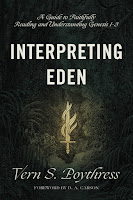
He begins with "basic interpretive principles," and that means he begins with God because "interpreting Genesis 1–3 depends on who we think God is. We need to interpret it bearing in mind that there is one true God, who created everything, who rules everything, and who can work miracles whenever he chooses" (p35). If there is a God, he can do as he pleases: he can let things runs, or he can involve himself.
He then talks about how we should think about the Bible and scientific claims before showing that our modern, "scientific" language is just as phenomenological as the ancients'. After discussing the genre that Gen 1-3 belongs to, he provides a helpful summary of those first 6 chapters.
Then he's on to "exegetical concerns" where he builds his case that the events of creation correspond to God's normal providential work in the universe and therefore should not be taken as metaphorical.
In part 3 he brings it all together to tell us what he actually thinks about Gen 1-3. Then there is a very helpful conclusion that summarizes everything.
This work is not a lay commentary, nor is it a popular apologetic work. There is technical language and long, complex arguments. I began to despair in the chapter on "Time in Genesis 1" that he would never get to the point. But he did. Reading this book will require a bit of effort from the reader. However, he has provided us with graphics that visualize many of his points and two excellent summaries of his argument (chapter 7 and then the conclusion) that help you wrap your head around what he's been saying. (I really have to emphasize that, though the bulk of the text is hard work, the summaries are very clear and extremely helpful. Every book should be so clearly summarized.)
In the end you will be convinced that it is possible to believe that the first three chapters of Genesis are literally true and that modern scientific theories are essentially correct. This work is well worth your time if you're at all interested in the topic.
NB: I received a free review copy.

He begins with "basic interpretive principles," and that means he begins with God because "interpreting Genesis 1–3 depends on who we think God is. We need to interpret it bearing in mind that there is one true God, who created everything, who rules everything, and who can work miracles whenever he chooses" (p35). If there is a God, he can do as he pleases: he can let things runs, or he can involve himself.
He then talks about how we should think about the Bible and scientific claims before showing that our modern, "scientific" language is just as phenomenological as the ancients'. After discussing the genre that Gen 1-3 belongs to, he provides a helpful summary of those first 6 chapters.
Then he's on to "exegetical concerns" where he builds his case that the events of creation correspond to God's normal providential work in the universe and therefore should not be taken as metaphorical.
In part 3 he brings it all together to tell us what he actually thinks about Gen 1-3. Then there is a very helpful conclusion that summarizes everything.
This work is not a lay commentary, nor is it a popular apologetic work. There is technical language and long, complex arguments. I began to despair in the chapter on "Time in Genesis 1" that he would never get to the point. But he did. Reading this book will require a bit of effort from the reader. However, he has provided us with graphics that visualize many of his points and two excellent summaries of his argument (chapter 7 and then the conclusion) that help you wrap your head around what he's been saying. (I really have to emphasize that, though the bulk of the text is hard work, the summaries are very clear and extremely helpful. Every book should be so clearly summarized.)
In the end you will be convinced that it is possible to believe that the first three chapters of Genesis are literally true and that modern scientific theories are essentially correct. This work is well worth your time if you're at all interested in the topic.
NB: I received a free review copy.
Wednesday, April 17, 2019
The Rest of the Gospel
Are we selling the gospel short?
Ask a child what the gospel is, and she'll (hopefully) say something like, "It's God forgiving your sins so you can go to heaven." And all of that is true.
As adults we should know that it's about so much more than that. But I think we forget.
Here's a verse almost everyone knows: "For God so loved the world that he gave his one and only Son, that whoever believes in him shall not perish but have eternal life" (John 3:16).
Here's one less well known: "Now this is eternal life: that they know you, the only true God, and Jesus Christ, whom you have sent" (John 17:3).
"Eternal life" is more than going to heaven. We get to know God!
Here's another one: "Therefore, if anyone is in Christ, he is a new creation: The old has gone, the new has come! All this is from God, who reconciled us to himself through Christ and gave us the ministry of reconciliation: that God was reconciling the world to himself in Christ, not counting people’s sins against them" (2Cor 5:17-19).
Through Christ's atoning death, through the forgiveness of our sins, "God was reconciling" us to himself. He was healing the broken relationship between us.
"To them God has chosen to make known among the Gentiles the glorious riches of this mystery, which is Christ in you, the hope of glory" (Col 1:27).
The mystery of the gospel is "Christ in you." We are united with Christ. God now lives in us.
"For those God foreknew he also predestined to be conformed to the image of his Son, that he might be the firstborn among many brothers and sisters" (Rom 8:29).
"For he chose us in him before the creation of the world to be holy and blameless in his sight. In love he predestined us for adoption to sonship through Jesus Christ, in accordance with his pleasure and will — to the praise of his glorious grace, which he has freely given us in the One he loves" (Eph 1:4-6).
And he has adopted us, rebellious sinners though we were and are, as his own children, "heirs of God and co-heirs with Christ" (Rom 8:17), and now "God raised us up with Christ and seated us with him in the heavenly realms in Christ Jesus" (Eph 2:6). This was the big plan. This isn't a fringe benefit. This is what God set out to do. We are forgiven, promised "eternal life", reconciled to God, and united with Christ so that we can be adopted.
So what is the gospel? It's God forgiving your sins through Christ so that he can make you his child.
I think this is the message our culture needs to hear today, partly because "heaven" seems to remote and far away, and partly because the child version of the gospel has become trite, I'm not sure people really listen to it anymore. But Christianity is not about an escape plan or a get-out-of-hell-free card. It's about becoming what God always intended us to be.
Jesus died on the cross to make us like him. And that is very good news.
"How great is the love the Father has lavished on us, that we should be called children of God!"
Ask a child what the gospel is, and she'll (hopefully) say something like, "It's God forgiving your sins so you can go to heaven." And all of that is true.
As adults we should know that it's about so much more than that. But I think we forget.
Here's a verse almost everyone knows: "For God so loved the world that he gave his one and only Son, that whoever believes in him shall not perish but have eternal life" (John 3:16).
Here's one less well known: "Now this is eternal life: that they know you, the only true God, and Jesus Christ, whom you have sent" (John 17:3).
"Eternal life" is more than going to heaven. We get to know God!
Here's another one: "Therefore, if anyone is in Christ, he is a new creation: The old has gone, the new has come! All this is from God, who reconciled us to himself through Christ and gave us the ministry of reconciliation: that God was reconciling the world to himself in Christ, not counting people’s sins against them" (2Cor 5:17-19).
Through Christ's atoning death, through the forgiveness of our sins, "God was reconciling" us to himself. He was healing the broken relationship between us.
"To them God has chosen to make known among the Gentiles the glorious riches of this mystery, which is Christ in you, the hope of glory" (Col 1:27).
The mystery of the gospel is "Christ in you." We are united with Christ. God now lives in us.
"For those God foreknew he also predestined to be conformed to the image of his Son, that he might be the firstborn among many brothers and sisters" (Rom 8:29).
"For he chose us in him before the creation of the world to be holy and blameless in his sight. In love he predestined us for adoption to sonship through Jesus Christ, in accordance with his pleasure and will — to the praise of his glorious grace, which he has freely given us in the One he loves" (Eph 1:4-6).
And he has adopted us, rebellious sinners though we were and are, as his own children, "heirs of God and co-heirs with Christ" (Rom 8:17), and now "God raised us up with Christ and seated us with him in the heavenly realms in Christ Jesus" (Eph 2:6). This was the big plan. This isn't a fringe benefit. This is what God set out to do. We are forgiven, promised "eternal life", reconciled to God, and united with Christ so that we can be adopted.
So what is the gospel? It's God forgiving your sins through Christ so that he can make you his child.
I think this is the message our culture needs to hear today, partly because "heaven" seems to remote and far away, and partly because the child version of the gospel has become trite, I'm not sure people really listen to it anymore. But Christianity is not about an escape plan or a get-out-of-hell-free card. It's about becoming what God always intended us to be.
Jesus died on the cross to make us like him. And that is very good news.
"How great is the love the Father has lavished on us, that we should be called children of God!"
Wednesday, April 3, 2019
Trusting God for the Consequences of Obedience
I hate admitting when I'm wrong.
Unless you're Rip Van Winkle, you're aware of the debates we've been having over immigration in the US in the last few years. The arguments have become vicious. Mostly they're over illegal immigration, but the effects have spilled over onto legal immigration as well. In the midst of this we have a number of humanitarian crises in the Middle East and in Latin America. People's homes have become unsafe, and they say they need somewhere to go — now!
And politically conservative evangelicals (not a completely redundant phrase) find themselves torn between two impulses.
On the one hand, care for the helpless — the widow and orphan, the alien, the refugee, "the least of these" — is frequently and strongly commanded in the Bible. God says again and again that he will judge people (and peoples) based on how they treat the weakest among them.
On the other hand, not only will helping these people be expensive for a nation that feels stretched too thin, this seems like it's just playing into the other (political) side's hands: namely, that these people will help tip American politics to the left for years to come (because the left seems to want to make all illegal immigrants citizens). The result of helping these people now may be to give up any chance of stopping the mass slaughter of unborn children for generations.
What do you do when you feel like you have to choose between obedience and ... obedience?
The first thing to do is recognize the difference between absolute facts and potentialities.
Second, those maybes need to be met with one very important question: Do you believe in the providence of God?
That's the question that has slapped me in the face. I've joked that I believe in the providence of God until I'm stuck in traffic. Well, it's really not a joke. It's pretty true. I say I believe in the providence, even sovereignty, of God, but when push comes to shove, does my life look like it? Or do I let the illusion that I can control anything beyond my own decisions direct my actions?
So I will try to take to heart the message of Shadrach, Meshach and Abednego: Just obey, and trust God is in charge of the consequences.
Unless you're Rip Van Winkle, you're aware of the debates we've been having over immigration in the US in the last few years. The arguments have become vicious. Mostly they're over illegal immigration, but the effects have spilled over onto legal immigration as well. In the midst of this we have a number of humanitarian crises in the Middle East and in Latin America. People's homes have become unsafe, and they say they need somewhere to go — now!
And politically conservative evangelicals (not a completely redundant phrase) find themselves torn between two impulses.
On the one hand, care for the helpless — the widow and orphan, the alien, the refugee, "the least of these" — is frequently and strongly commanded in the Bible. God says again and again that he will judge people (and peoples) based on how they treat the weakest among them.
On the other hand, not only will helping these people be expensive for a nation that feels stretched too thin, this seems like it's just playing into the other (political) side's hands: namely, that these people will help tip American politics to the left for years to come (because the left seems to want to make all illegal immigrants citizens). The result of helping these people now may be to give up any chance of stopping the mass slaughter of unborn children for generations.
What do you do when you feel like you have to choose between obedience and ... obedience?
The first thing to do is recognize the difference between absolute facts and potentialities.
Fact: Refugees.That's a lot of maybes.
Potentiality: Maybe conservatives will eventually be able to put the right people on the courts to overturn Roe. Maybe every illegal alien granted citizenship will vote Democrat. Maybe that would let them keep stocking the courts with pro-abortion ideologues.
Second, those maybes need to be met with one very important question: Do you believe in the providence of God?
That's the question that has slapped me in the face. I've joked that I believe in the providence of God until I'm stuck in traffic. Well, it's really not a joke. It's pretty true. I say I believe in the providence, even sovereignty, of God, but when push comes to shove, does my life look like it? Or do I let the illusion that I can control anything beyond my own decisions direct my actions?
So I will try to take to heart the message of Shadrach, Meshach and Abednego: Just obey, and trust God is in charge of the consequences.
Wednesday, March 20, 2019
A Trustworthy Saying on Salvation
"You can't turn a pickle back into a cucumber."
Every culture has sayings that become maxims or, occasionally, mantras. "A stitch in time saves nine." "A penny saved is a penny earned."
In the pastoral letters, Paul shares what appear to have been common sayings in the early church that he found "trustworthy." The first and probably the most commonly known today is:
This is the most basic statement of the gospel. It's not the whole of the gospel, but it is the foundation. Christ came to save sinners, and this is Good News because we're all sinners. God saw our sorry state and had pity on us. He came to rescue us from our rebellion.
We would have no hope if it weren't for God's grace. Not only did we have nothing to offer God, we aren't even capable of trusting him without his supernatural help. We weren't just broken, we were dead in our trespasses. Christ doesn't fix us; he gives us life!
And somehow we manage to get prideful anyway.
We tell the story of "the Pharisee and the Publican," but it's still so easy for us to believe that there are those who don't deserve salvation — as if we deserved it! "I may have been a drunkard, a serial adulterer, a blasphemer, and a tax cheat, but murderers can't be saved."
And that's why the best part of this trustworthy saying is the part that Paul almost certainly added himself:
"Christ Jesus came into the world to save sinners—of whom I am the worst."
I don't care if you actually were a drunkard, a serial adulterer, a blasphemer, and a tax cheat or if you were saved at six-years-old and the worst sin you'd ever committed was sticking your tongue out at your mommy, that "of whom I am the worst" is the attitude to plant into your heart.
We must never let ourselves believe there is one sin so terrible that someone doesn't deserve to be saved. Every sin is so terrible that we don't deserve to be saved. But God's desire is to save the vilest sinners so that "in me, the worst of sinners, Christ Jesus might display his immense patience as an example for those who would believe in him and receive eternal life" (1 Tim 1:16).
God can save a child molester. God can save a cannibal. God can save a terrorist. God can save a mass murderer.
I get teary-eyed listening to stories from prison ministries because there are few things more beautiful than telling a man who's been locked away, who's been told society is not a place for him, that God will welcome him into his family.
I tell you if Hitler had repented and trusted Christ, there would have been "rejoicing in the presence of the angels of God" because "Christ Jesus came into the world to save sinners."
Every culture has sayings that become maxims or, occasionally, mantras. "A stitch in time saves nine." "A penny saved is a penny earned."
In the pastoral letters, Paul shares what appear to have been common sayings in the early church that he found "trustworthy." The first and probably the most commonly known today is:
"Here is a trustworthy saying that deserves full acceptance: Christ Jesus came into the world to save sinners" (1Tim 1:15).Amen and hallelujah!
This is the most basic statement of the gospel. It's not the whole of the gospel, but it is the foundation. Christ came to save sinners, and this is Good News because we're all sinners. God saw our sorry state and had pity on us. He came to rescue us from our rebellion.
We would have no hope if it weren't for God's grace. Not only did we have nothing to offer God, we aren't even capable of trusting him without his supernatural help. We weren't just broken, we were dead in our trespasses. Christ doesn't fix us; he gives us life!
And somehow we manage to get prideful anyway.
We tell the story of "the Pharisee and the Publican," but it's still so easy for us to believe that there are those who don't deserve salvation — as if we deserved it! "I may have been a drunkard, a serial adulterer, a blasphemer, and a tax cheat, but murderers can't be saved."
And that's why the best part of this trustworthy saying is the part that Paul almost certainly added himself:
"Christ Jesus came into the world to save sinners—of whom I am the worst."
I don't care if you actually were a drunkard, a serial adulterer, a blasphemer, and a tax cheat or if you were saved at six-years-old and the worst sin you'd ever committed was sticking your tongue out at your mommy, that "of whom I am the worst" is the attitude to plant into your heart.
We must never let ourselves believe there is one sin so terrible that someone doesn't deserve to be saved. Every sin is so terrible that we don't deserve to be saved. But God's desire is to save the vilest sinners so that "in me, the worst of sinners, Christ Jesus might display his immense patience as an example for those who would believe in him and receive eternal life" (1 Tim 1:16).
God can save a child molester. God can save a cannibal. God can save a terrorist. God can save a mass murderer.
I get teary-eyed listening to stories from prison ministries because there are few things more beautiful than telling a man who's been locked away, who's been told society is not a place for him, that God will welcome him into his family.
I tell you if Hitler had repented and trusted Christ, there would have been "rejoicing in the presence of the angels of God" because "Christ Jesus came into the world to save sinners."
Subscribe to:
Posts (Atom)