“Edom will become an object of horror; all who pass by will be appalled and will scoff because of all its wounds. As Sodom and Gomorrah were overthrown, along with their neighboring towns,” says the Lord, “so no one will live there; no people will dwell in it” (Jer 49:17-18).

It’s good to know that the biblical text is reliable, but wouldn’t it be nice to have some kind of sign that the Bible is more than just the words of men? We have that in the fulfilled prophecies of the Bible.
If you don’t believe in God, it’s hard to explain prophecies. Skeptics usually assume that any prophecy in the Bible that “came true” was either so vague as to be meaningless (like a carnival fortune teller) or must have been written after the fact, but that ploy doesn’t work with every prophecy. There are too many of them that are too specific and which could not have been written later.
One of these is the above prophecy against Edom, one of many about them. God promised these long-time enemies (and relatives) of the Jews during the time of the Babylonian captivity that their land would lie desolate. Even if this prophecy were “really written” a couple of hundred years later, that wouldn’t help the skeptic’s case as the prophecy wasn’t fulfilled until 400 years later, after the time of Christ.
After the fall of Jerusalem in AD 70, “the children of Esau disappear as a separate people from the stage of recorded history.” (1) Edom became a wasteland. In modern times, “the Arabs, in general, avoid the ruins of the cities of [Edom] on account of the enormous scorpions with which they swarm.” (2)
This is far from the only fulfilled prophecy in scripture. Promises against Tyre, Sidon, and, of course, Jerusalem, among others, were fulfilled. Cyrus the Great was named by name before he was even born (Is 44:28, 45:1). The rise and fall of Babylon, Persia, Greece, and Rome were predicted (Dan 2).
And, though I don’t want to go into detail now, the birth, life, ministry, death, and resurrection of Christ were predicted in stunning detail hundreds of years before he was born.
The cumulative effect of all of this?

“Picture a pond with a sandy bottom and flat rocks on the shore but no rocks in the water. Now picture a boy who discovers the lake and skips a few rocks. A century later another boy also skips some rocks across the pond. Another century goes by and another boy skips more rocks on the pond. Imagine then climbing a tall tree by the pond and discovering that there was an excellent portrait done in mosaic on the bottom of the pond made from the skipping stones. This is what prophecy is like.” (3)
The Bible is made up of reliable historical documents written by eyewitnesses. We now can say that what those witnesses saw had been predicted beforehand. No mere mortal could predict what the prophets predicted. The fulfilled prophecies of the Bible prove there is supernatural power behind the scriptures. If God was behind the prophecies about Tyre and Cyrus, there is no reason to doubt he was behind the Bible’s moral teachings, the gospel of grace, and the hope extended by Christ Jesus to all who trust in him.
(1) David Higgins, quoted in A Ready Defense by Josh McDowell
(2) George Smith, quoted by McDowell
(3) Doug Powell, Holman QuickSource Guide to Christian Apologetics
Image credits:
Petra tombs, Saturn83, creative commons
Christ Pantocrator mosaic from Hagia Sophia, Jim Forest, creative commons
Part of Christianity 101
“In the fifteenth year of the reign of Tiberius Caesar—when Pontius Pilate was governor of Judea, Herod tetrarch of Galilee, his brother Philip tetrarch of Iturea and Traconitis, and Lysanias tetrarch of Abilene ... the word of God came to John son of Zechariah in the wilderness” (Luke 3:1-2).
I want to set expectations low from the outset. There are no non-Christian documents that prove Jesus rose from the dead. For one thing, if any document says Jesus rose from the dead, it’s immediately classified as a Christian document. But there is extra-biblical support for the broad outline of the story, and there is archaeological evidence that the NT writers were, at the very least, not writing high fantasy — that they were writing about the world around them.

First we’ll talk about the non-Christian historical documents. During his life, Jesus was a big nobody. I know, he drew big crowds, worked miracles, and said all kinds of controversial things, but the Roman Empire was a big place, and Judea was an unpopular backwater. Yet another crazy prophet running around Palestine was not going to attract much attention. And in the pre-modern world, the three-ish years of his ministry wasn’t time for much news to even get out.
So the historical evidence for the existence of Jesus comes from several years after his ministry. The primary evidence comes from the Jewish historian Josephus (37-100) and the Roman historian Tacitus (56-120). Suetonius, Pliny the Younger, Thallus, and rabbic tradition offer a little more material. The relevant passages are interesting, but for our purposes I will only quote historian Edwin Yamauchi’s summary of the picture these various ancient documents paint of Jesus. If we lost the New Testament, what would we know about Jesus?
“We would know that first, Jesus was a Jewish teacher; second, many people believed that he performed healings and exorcisms; third, some people believed he was the Messiah; fourth, he was rejected by the Jewish leaders; fifth, he was crucified under Pontius Pilate in the reign of Tiberius; sixth, despite this shameful death, his followers, who believed that he was still alive, spread beyond Palestine so that there were multitudes of them in Rome by A.D. 64; and seventh, all kinds of people from the cities and countryside—men and women, slave and free—worshiped him as God.”
Is this enough to make people fall down and worship Jesus? Of course not. But it’s ample evidence that the stories told in the gospels have at least some historical basis.
The second type of evidence is the archaeological data. The question is whether archaeology supports the historicity of the New Testament accounts. In recent history, people have tended to assume the worst. If the NT speaks of a person or place that we have no other information about, it is assumed to be a fabrication. Until the evidence emerges.
One example is Luke’s reference to Lysanias as tetrarch quoted above. As archaeologist John McRay tells it, “For years scholars pointed to this as evidence that Luke didn’t know what he was talking about, since everybody knew that Lysanias was not a tetrarch but rather the ruler of Chalcis half a century earlier.” That is until “an inscription was found from the time of Tiberius ... which names Lysanius as tetrarch.” Time and again critics have accused Luke of being loose with the details or even making things up. Time and again he has been shown to be a very careful historian.
The same thing has happened with some other writers. For example, John 5 tells about Jesus healing a man at the Pool of Bethesda. For years this was cited as proof the John didn’t know Jerusalem because no such place existed. You can now visit the ruins.
Again and again archaeology has vindicated both the New Testament and the Old. This is not proof that the stories they tell are true, but it does provide strength to the argument that the authors were indeed present and trying to recount history rather than just writing wild fantasies.
The stories recounted in the Bible are fantastic. But that doesn’t mean they didn’t really happen. If they did, if a man who died on a Roman cross really rose from the dead, then everything he said is worth paying attention to.
For more information, see The Case for Christ by Lee Strobel.
Image credit: The Pool of Bethesda by Robert Bateman, 1877
Part of Christianity 101
“For we did not follow cleverly devised stories when we told you about the coming of our Lord Jesus Christ in power, but we were eyewitnesses of his majesty” (2 Peter 1:16).
If someone were to tell you an incredible, supernatural story, what would be your first question? It would probably be, “Did you actually see it?” You wouldn’t treat an urban legend or a story your friend got from his friend’s cousin’s uncle the same way you’d treat something your friend saw with his own eyes. We want our news to come from people who saw it or, failing that, people who talked to the people who did.
So did the gospels come from people who were there? Some of them. Tradition says the Gospels According to Matthew* and John were written by actual apostles and that Mark’s was a record of Peter’s teaching. Luke “carefully investigated everything” (Luke 1:3) before giving us his account, suggesting that he spoke to as many witnesses as he could get his hands on.
And there were still witnesses. People debate when the gospels were written, but only the most close-minded opponents date them outside of possible lifetimes of witnesses. Conservatives think Mark may have written his gospel as early as the mid 50s; liberals and skeptics put it in the 70s. Dates for Luke range from the late 50s/early 60s to the mid 80s. In either case we’re talking about a period well within the lifetime of witnesses to the kinds of things people would not forget. So if the gospel writers were making things up, there would have been people around who could object.
And the first generation of the church knew the power of eye witness reports. The quote above from Peter is similar to the assurance given by John: “That which was from the beginning, which we have heard, which we have seen with our eyes, which we have looked at and our hands have touched—this we proclaim concerning the Word of life” (1 John 1:1). The message of the apostles was “we’re telling you what we saw.” The Church would not have accepted the written gospels if they were from just anyone.
But is there any actual evidence that these accounts come from witnesses? Yes.
There are two “minor” things that I think make a major difference. The first is the use of names and locations in the gospels. As Richard Bauckham has shown in his Jesus and the Eyewitnesses, the names used in Judea and Galilee were different than Jewish names in other parts of the world, and the gospel writers not only use the right names, but they disambiguate the right names — that is, they know which names are common and make it clear who they’re talking about. So, for example, we don’t need to disambiguate a less common name like Andrew, but we need to know that the Joseph who asked for Christ’s body is the one from Arimathea.

In a similar manner, the geography in the gospels makes sense. The right towns have gentiles, and the towns with tax collectors are the kinds of town where you would expect them. Unlike later “gospels” like Thomas or Mary, the canonical gospels go into quite a bit of detail about the geography of Palestine, and they get it all right, suggesting that these stories come from people who were there. As Peter Williams pointed out, you couldn't just google these details back then. The kind of details they casually drop into the narrative are evidence that the stories originated from that part of the world.
The second “minor” thing is something known as undesigned coincidences. For example, in John’s account of the feeding of the five thousand, Jesus asks Philip where they can get bread for everyone (6:1-5). Why Philip? Philip was from Bethsaida (John 1:43-44), and as Luke alone tells us, this event occurred near Bethsaida (9:10). Undesigned coincidences are all these kinds of little, insignificant details that really could not have been coordinated but allow one author to clarify another. These are only possible because the authors are telling stories that really happened. Whole books are dedicated to identifying these things, the most recent of which is Hidden in Plain View by Lydia McGrew.
Any one of these things might be brushed off, but together they make a pretty strong case. So I think we can have confidence that we have not believed “cleverly devised fables” but true stories about the most amazing thing that has ever happened in the history of the world. If these stories are true, they beg the question, “What will you do about it?” How should we live if these stories are true?
For more information, see a different Can We Trust the Gospels?, this one written by Peter J Williams.
* I’m not going to go into detail on this, but suffice it to say, if you were going to make up names for the authors of the gospels, Matthew, Mark, and Luke are pretty much the last names you’d fabricate.
Image credit: Tamar Levine under Creative Commons
Part of Christianity 101
“Then everyone deserted [Jesus] and fled” (Mark 14:50).
Even if we have the actual words of the apostles, why should we think they were telling the truth? Especially in the gospels, so many fantastic things are described that it seems obvious that they had no problem making things up.
It’s a valid question. I think the best way to address it is to ask what you would include if you were going to make up a story to start a new religion. You’d make sure the founder seemed wise and witty. Check. You’d give him awesome powers. Check. You’d make sure the leaders of your new religion looked good. Um, wait a second.
It’s called the criterion of embarrassment. Do the writers include things they didn’t have to include, things that are embarrassing? The apostles don’t look that good in the gospels. The twelve consistently misunderstand Jesus (eg, Matt 16:5-7). They act like children (eg, Mark 10:35-37). They abandoned Jesus in the garden, and Peter denied even knowing him (Mark 14:66-72).
Even Jesus doesn’t always look as good as he might. He’s rejected by his own family (eg, Mark 3:21). There are things he doesn’t know (eg, Matt 24:36). He can’t seem to do many miracles in his hometown (Mark 6:5). Most of all, crucifixion was a shameful death. These aren’t things you’d make up. But by including them, the authors show they’re trying to be honest.
One of the authors also included a statement about his honest intentions:
Many have undertaken to draw up an account of the things that have been fulfilled among us, just as they were handed down to us by those who from the first were eyewitnesses and servants of the word. With this in mind, since I myself have carefully investigated everything from the beginning, I too decided to write an orderly account for you, most excellent Theophilus, so that you may know the certainty of the things you have been taught. (Luke 1:1-4)
Luke wanted this disciple, Theophilus, to know the truth of the matter. This statement is about as far from “once upon a time” as you can get. Luke is saying “I checked everything out, and here’s the real story.”
But, some will say, the gospel writers had an agenda, they were biased. John even plainly says, “Jesus performed many other signs in the presence of his disciples, which are not recorded in this book. But these are written that you may believe that Jesus is the Messiah, the Son of God, and that by believing you may have life in his name” (20:30-31). The apostles wanted people to believe, so they told them what they thought would make them believe.
Duh. Of course they were biased. Of course they wanted people to believe. That doesn’t mean they weren’t telling the truth.
Peter Williams, principal of Tyndale House, wrote in his Can We Trust the Gospels?:
... Bias does not mean we should distrust their record. An innocent man accused of a crime may have a deep interest in proving his innocence, but this bias is not a reason to dismiss evidence he produces. The question, then, is not whether the Gospel writers had an agenda, but whether they reported accurately.
Unless someone is determined to reject the gospels a priori or simply cannot have an open mind because of miraculous stories, there is no reason to doubt that the gospel writers were trying to honestly convey the stories about Jesus.
And there’s a lesson here for us. When the first generation of the church was writing down the oral traditions about Jesus, they chose to tell the stories about their founder and their leaders in all the unvarnished truth. They did not pretend Jesus was universally loved and admired. They did not pretend the apostles were paragons of virtue. They told the truth and trusted God for the results.
Today, though, many Christians are afraid to admit, much less confront, the faults of their leaders. Some are afraid that allowing scandal to come to light may turn people off of the church. Well, the truth has a tendency to come out anyway, and then we look dishonest. We have to be committed to the truth and to living like Christ and let God be responsible for what happens from there.
For more information, I recommend Can We Trust the Gospels?: Investigating the Reliability of Matthew, Mark, Luke, and John by Mark D. Roberts.
Part of Christianity 101
“From time to time an angel of the Lord would come down and stir up the waters. The first one into the pool after each such disturbance would be cured of whatever disease they had” (John 5:4).
If the above verse appears in your Bible at all, it will probably be in a footnote. It is not considered to be part of the biblical text anymore. Does that seem like an odd choice to start talking about why we can trust the Bible? Let me explain.

The New Testament was complete before AD 100. The Gutenberg printing press arrived in 1450. Until then, every copy of the Bible was made by hand. When hand copying anything of any length, copying mistakes are inevitable. Over the centuries typos naturally crept into the text. There were also additions to the text. Some were well-intentioned attempts to harmonize passages or to explain something in the text; others were probably just marginal notes a copyist thought were supposed to be part of the passage. In total the NT grew a couple of percent over those 1400 years.
We do not have the original writings of the New Testament authors. We probably don’t even have copies of copies of them. So how can we know that what we have is what they wrote?
It’s important to know that this situation is not unique to the Bible. Every ancient document has this same problem. A discipline called “textual criticism” was created to compare the copies we have to work back to the originals.
The usual example goes something like this: Suppose a group of thirty people were asked to copy a letter. Each of those thirty copies would have errors. But each would have different errors than the others. If the original were removed, you could compare them and determine what the original said. If you only had two copies, any time there was a difference you would have a 50-50 chance of getting the correct result. With 5 copies, it would usually be obvious what the correct reading was. The more copies you have, the easier it is to discern what the original said.
Now we have copies of copies of copies of copies, so there are errors that are transmitted to the next generation of copies, and then new errors are made as well, but by determining which copies are older and comparing and weighting what we have, experts can work their way back to the original text.
Again, this is not confined to the Bible. Homer, Julius Caesar, Tacitus, Herodotus, and Plato are the big name examples, but everything written before the widespread use of the printing press falls under this problem.
However the New Testament stands out in one respect: we have many more, and earlier, copies of it than of any other ancient work. As the late, eminent F. F. Bruce said, “There is no body of ancient literature in the world which enjoys such a wealth of good textual attestation as the New Testament.”
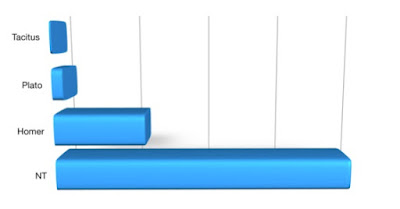 |
| # of copies compared |
The result is that we have absolutely no doubt as to what greater than 99.7% of the NT says. Of the remaining 0.2-ish%, it is generally a matter of one word in a sentence that might be this or that. In no case do any of these uncertainties cast doubt on any major doctrines.
If someone gave you $100 dollars in pennies, and someone else came along and told you there was a chance that 2 of those 10,000 pennies were counterfeit, how concerned would you be?
The situation is not quite as tidy for the Old Testament — it’s more like 95%. But the Christian faith is built on the teachings of the apostles in the NT. The OT is history and background for the NT. Remember, the old covenant has been completed and set aside in favor of the new covenant established by Christ. A little bit of uncertainty about a line here or there in the OT does not undermine the Christian faith.
Thanks to textual criticism, we can identify all the places where words (or sentences) were added to the text. Places like the verse above have been removed. Two holdouts remain. The story of the woman caught in adultery (John 7:53-8:11) and the so-called long ending of Mark (16:9 and following) remain in the Bible but with notes like this one in Mark: “The earliest manuscripts and some other ancient witnesses do not have verses 9–20.” So there are no dirty little secrets. This is in the text, spelled out for all who care to see.
Skeptics today make a lot of noise about the copying errors in the Bible. They vastly overstate their case. They want you to doubt your Bible. You don’t need to. Even if we didn’t have the modern critical text, we would have everything we need for salvation, to know God, and to live the life he desires. But we do have the modern text, and we have no reason to doubt that it gives us the actual words of the apostles of Jesus Christ.
God has made sure that we have his word 2,000 years after it was written. What do you think the appropriate response to that should be?
For more information on this topic, see Dethroning Jesus by Bock and Wallace.
Photo credit: "Pennies" by foreverseptember
Part of Christianity 101


